
April 22, 2026
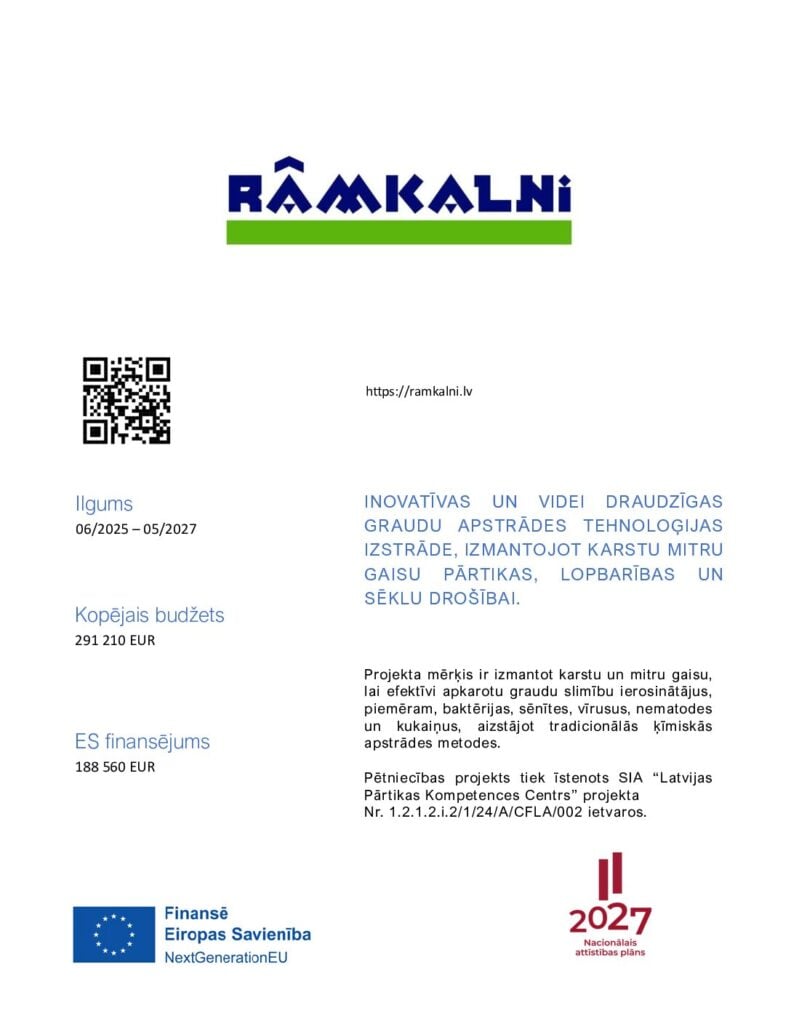
PROJECT No 1.2.1.2.i.2/1/24/A/CFLA/002
Project implementation period: June 2025 – May 2027
Title: Development of an innovative and environmentally friendly grain processing technology using hot humid air for food, feed and seed safety
Study No EN-13
The study is being carried out as part of a project run by SIA LATVIJAS PĀRTIKAS KOMPETENCES CENTRS.
Period: 01.07.-31.08.2025
The project has fully implemented the following activities:
The efficiency and mechanism of action of hot humid air treatment of grain were investigated with the aim of determining the optimum technological parameters for the total or partial destruction of pathogenic micro-organisms (bacteria, fungi and viruses) and pests, while preserving grain quality and germination. Result achieved: Optimum parameters for hot humid air treatment have been identified which effectively kill pathogens and pests while maintaining grain quality, nutritional value and germination.
Period: 1 September 2025 – 2 February 2026
The following activities were carried out as part of the project: Analysis of the effect of humid karst air on the germination capacity, nutritional value and physical properties of grain following treatment – A comparison was made between treated and untreated grain; Guidelines were developed for treatment to ensure maximum preservation of grain quality and nutritional value; A technological process for grain treatment was developed.
Result achieved: The results confirm that hot, humid air technology can be an effective tool for stabilising grain quality. Excessive temperatures or prolonged processing can have a negative impact on the structure of the grain and certain nutritional parameters. It is therefore essential to select the optimal technological parameters.
In the next phase of the study, it will be important to determine the optimal parameters for temperature, humidity and processing time in order to achieve maximum efficiency, whilst preventing any deterioration in the structure or nutritional value of the grain.
The results of the completed work provide a basis for future project activities. The technological process developed will be used as a basis for further refinement of the technology and for analysing the optimisation of energy and water consumption.


